


More Views


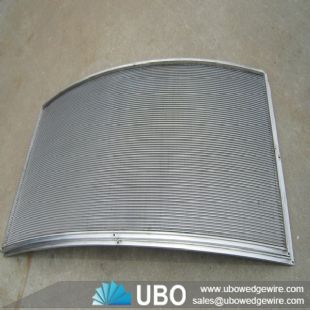
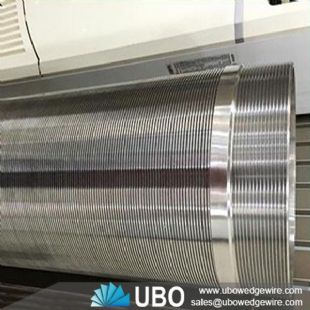
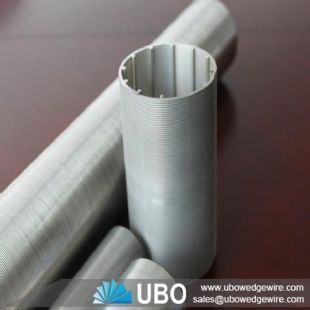
316 wedge wire sieve bend screen
| Category: | Wedge Wire Application |
|---|---|
| Material: | stainless steel304,316,316L |
| Properties: | wedge wire screen |
| Application: | water filtration,oil filtration,liquid filtration,industry filtration |
if you are interested in receiving more information or have a question regarding any of our products please fill out the form above and we will contact you within 24-48 hours.


Details of 316 wedge wire sieve bend screen
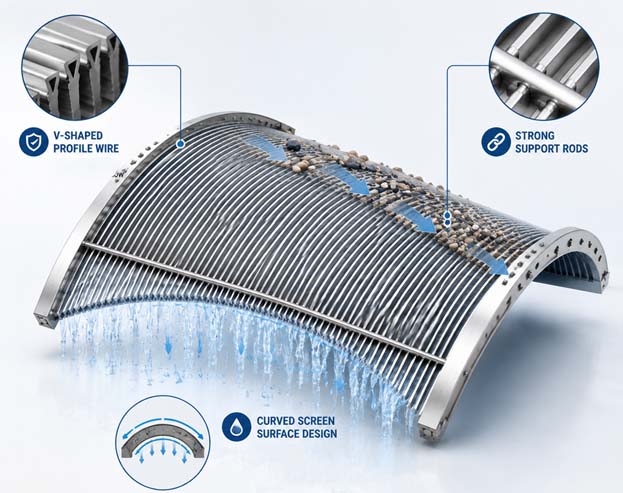
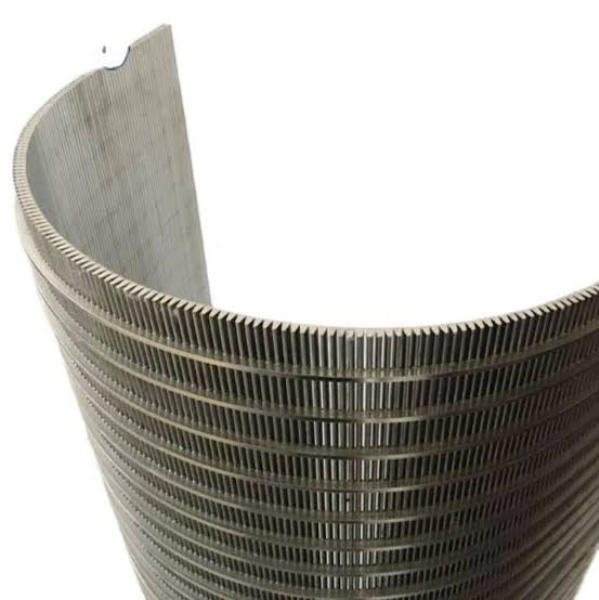
A wedge wire sieve bend screen, also known as a DSM screen or curved wedge wire screen, is a stationary screening system consisting of wedge-shaped profile wires welded onto supporting rods.
The screen surface is installed at a specific angle, allowing slurry or process liquid to flow over the curved surface. During operation, liquid passes through the narrow slot openings, while larger particles, fibers, and suspended solids are separated and discharged.
The unique V-shaped wire profile creates a continuous slot opening that provides:
- Accurate particle separation
- Reduced clogging compared with conventional perforated screens
- High open screening area
- Efficient liquid drainage
- Easy cleaning and maintenance
The design makes wedge wire sieve bend screens particularly suitable for applications requiring continuous filtration and dewatering without rotating or vibrating components.
Construction and Design Features
1. V-Shaped Profile Wire Design
The most important feature of a wedge wire sieve bend screen is the V-shaped profile wire.
The tapered slot geometry creates a wider opening toward the inside of the screen, which helps prevent particles from becoming trapped inside the openings.
This design provides:
- Lower risk of blockage
- Stable flow performance
- Improved screening efficiency
- Easier backwashing or cleaning
Compared with traditional punched plates or woven mesh screens, wedge wire technology provides a smoother screening surface and more consistent separation performance.
2. Strong Support Rod Structure
Profile wires are resistance welded onto support rods to form a rigid screening structure.
The support system provides:
- High mechanical strength
- Accurate slot spacing
- Resistance against deformation under continuous slurry flow
This structure allows the screen to maintain its original geometry during long-term industrial operation.
3. Curved Screen Surface Design
The curved shape is one of the main reasons sieve bend screens achieve high separation efficiency.
When slurry flows across the curved surface:
- Gravity accelerates liquid drainage
- Solids move gradually toward the discharge area
- The contact time between material and screen surface increases
This passive separation method reduces energy consumption because the screening process does not require motors or vibration systems.
How Does a Wedge Wire Sieve Bend Screen Work?
The working principle of a wedge wire sieve bend screen is based on controlled size separation.
Step 1: Slurry Feeding
The mixture enters from the upper feeding section and spreads evenly across the curved screen surface.
Step 2: Flow Separation
As the slurry moves downward, the liquid portion passes through the precisely designed slot openings.
Step 3: Solid Retention
Particles larger than the selected slot size remain on the screen surface and continue moving downward.
Step 4: Material Discharge
Separated solids are discharged from the lower end, while filtered liquid is collected below the screen.
The actual separation performance depends on several factors, including:
- Slot opening size
- Particle shape
- Feed concentration
- Slurry viscosity
- Screen angle
- Flow velocity
Therefore, selecting the correct wedge wire sieve bend screen design is essential for achieving stable operation.
Why Choose 316 Stainless Steel for Wedge Wire Sieve Bend Screens?
316 stainless steel is commonly selected for industrial sieve bend screens where corrosion resistance and hygienic performance are important.
Compared with standard stainless steel grades, 316 stainless steel provides better resistance in environments containing:
- Cleaning chemicals
- Salts and chlorides
- Organic process materials
- Moisture-rich production conditions
In sugar processing plants, equipment frequently contacts sugar juice, washing water, and cleaning solutions. The corrosion-resistant properties of 316 stainless steel help maintain screen integrity and reduce replacement frequency.
Key advantages include:
- Suitable for food and beverage applications
- Excellent corrosion resistance
- Easy surface cleaning
- Good mechanical durability
- Long-term dimensional stability
Applications of Wedge Wire Sieve Bend Screen in Sugar Processing
Sugar production involves multiple separation stages where efficient solid-liquid separation directly affects product quality and process efficiency.
1. Sugar Juice Filtration
During sugar cane processing, raw juice contains:
- Bagasse fibers
- Plant particles
- Suspended solids
- Insoluble impurities
Wedge wire sieve bend screens are used to remove larger suspended materials before further clarification processes.
Benefits include:
- Reduced load on downstream filtration equipment
- Improved juice cleanliness
- More stable processing conditions
2. Bagasse Dewatering
After juice extraction, bagasse contains a significant amount of moisture.
A sieve bend screen helps separate water from bagasse materials by allowing liquid drainage while retaining fibrous solids.
This can help:
- Reduce moisture content
- Improve fuel efficiency when bagasse is reused
- Recover valuable process liquid
3. Sugar Juice Clarification Preparation
Before evaporation and crystallization, sugar juice requires effective removal of suspended impurities.
Wedge wire screening helps improve upstream separation efficiency by reducing unwanted solids entering clarification equipment.
4. Process Water Recycling
Sugar factories often recycle process water to improve sustainability.
316 wedge wire sieve bend screens can be applied for:
- Suspended solids removal
- Wastewater pretreatment
- Water recovery systems
Custom Wedge Wire Sieve Bend Screen Options
Ubowedgewire provides customized sieve bend screen solutions according to customer process requirements.
Available customization includes:
- Stainless steel material selection
- Slot opening size
- Screen width and length
- Curvature design
- Support rod configuration
- Frame structure
- Connection method
Custom designs allow the screen to be optimized for different applications including sugar processing, wastewater treatment, mining, and chemical separation.
Installation and Maintenance Recommendations
To maintain stable performance, regular inspection is recommended.
Important maintenance practices include:
- Check slot openings for blockage
- Remove accumulated solids regularly
- Inspect welding points and support structure
- Avoid mechanical impact on screen surface
- Clean according to process requirements
Because wedge wire screens have a smooth continuous surface, routine maintenance is usually simpler compared with woven mesh screens.
316 stainless steel wedge wire sieve bend screens provide an efficient solution for continuous solid-liquid separation in sugar processing and other industrial applications.
With V-shaped slot design, strong welded construction, and corrosion-resistant stainless steel material, these screens help improve separation efficiency, reduce maintenance requirements, and support stable production processes.

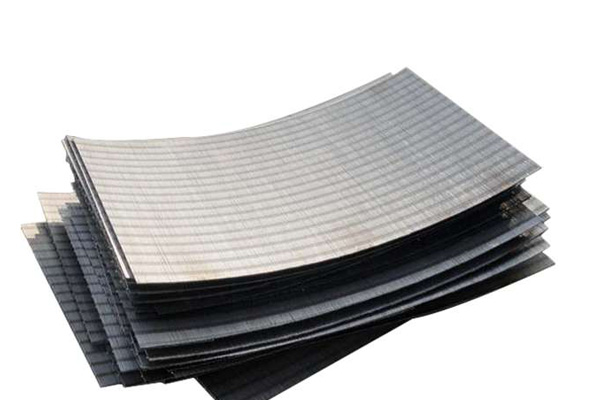
Specifications of 316 wedge wire sieve bend screen:
Material:stainless steel
Type:flat screen panel
Application:water filtration,oil filtration,liquid filtration,industry filtration
length:max 6meter
width:asyour request
curve angle:as your request


Packaging and Transportation of 316 wedge wire sieve bend screen:

You may also be interested in the following product(s)
Compare Products



 Tel
Tel
 WhatsApp
 Message
 Email
Email
- Contact Us
- Name:Xueyi Ma
- Tel:+86 311 8595 5658